
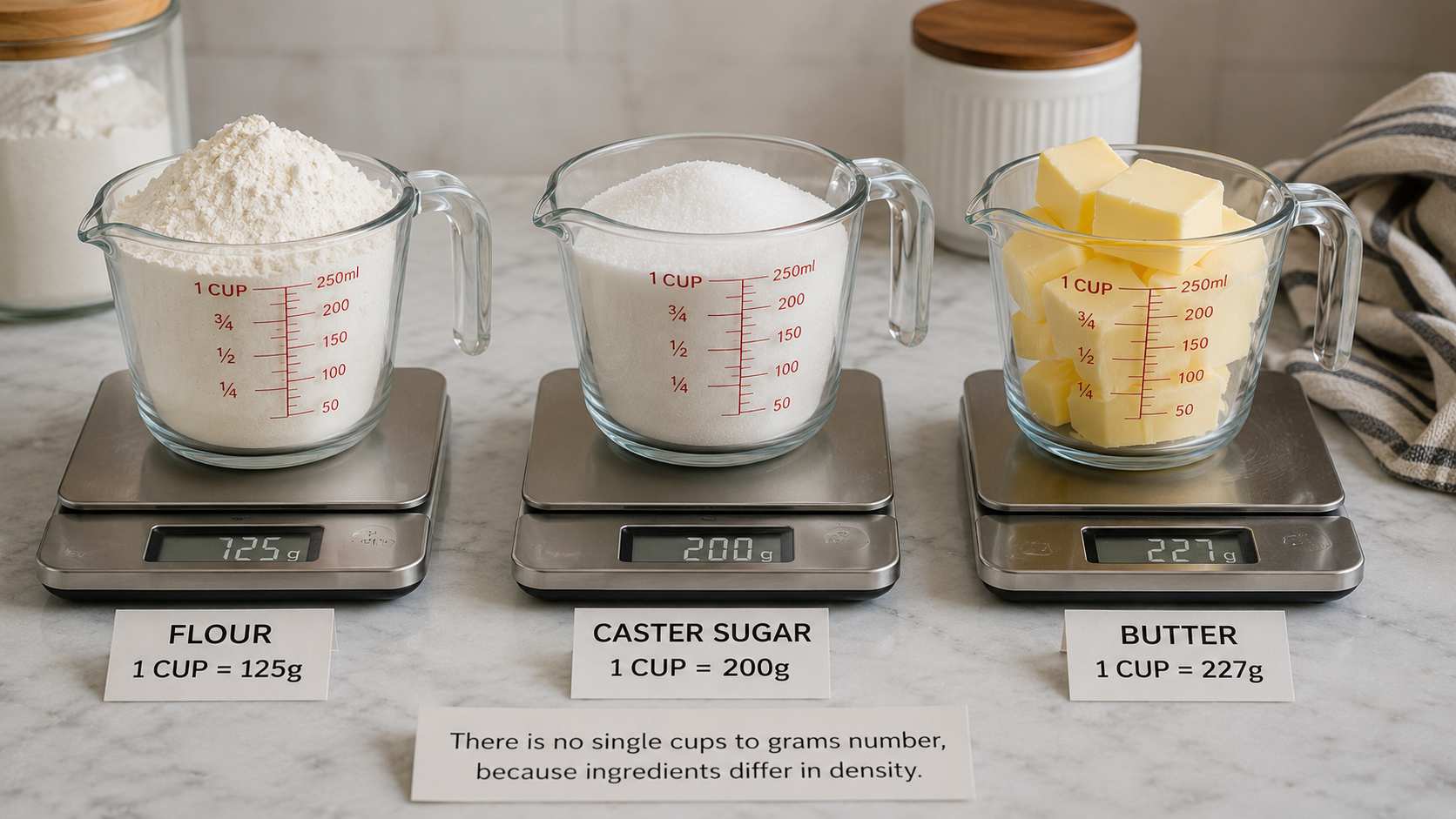
A cup of plain flour weighs about 125g, a cup of caster sugar about 200g, and a cup of butter about 227g. If you came here looking for one number to convert cups to grams, that is the honest answer to why there is not one: a cup is a measure of volume, a gram is a measure of weight, and different ingredients pack very differently into the same space.
The conversions that come up most
- Plain or self-raising flour: 1 cup is 125g
- Strong bread flour: 1 cup is 130g
- Wholemeal flour: 1 cup is 130g
- Caster or granulated sugar: 1 cup is 200g
- Soft brown sugar, packed: 1 cup is 220g
- Icing sugar, sifted: 1 cup is 125g
- Butter: 1 cup is 227g, which is two US sticks
- Rolled oats: 1 cup is 90g
- Rice, uncooked: 1 cup is 185g
- Water, milk or any thin liquid: 1 cup is 240ml, weighing about 240g
Those ten cover the large majority of recipes. Note how far apart flour and sugar sit at 125g and 200g. Using a single average would put a cake out by a third on the flour, which is more than enough to ruin it.
Why flour is the one to be careful with
Flour compacts. Scoop a cup straight from the bag and you can easily pick up 150g or more, because the scooping action presses the flour down. Spoon it loosely into the cup and level the top with a knife and you will get closer to 125g.
That variation of twenty per cent is why American recipes so often specify spooned and levelled flour, and why the same recipe can produce a light sponge one week and a dense one the next. If you have kitchen scales, weighing flour removes the problem entirely and takes less time than levelling a cup.
Sugar does not have this problem. Granulated and caster sugar are dense and free-flowing, so they pack consistently however you fill the cup. Soft brown sugar is the exception, since recipes assume it is pressed firmly into the cup, and a loosely filled cup of brown sugar can be 40g light.
Butter, and the stick problem
American recipes usually give butter in sticks rather than cups. One stick is 113g, or half a cup, or eight tablespoons. Two sticks make the 227g cup above. A standard UK butter block is 250g, so a stick is a little under half a block.
The simplest approach is to ignore cups for butter altogether. Weigh it, or use the printed markings on the wrapper of a British block, which are usually in 25g or 50g increments.
UK cups against US cups
Most recipes written in cups are American, and a US cup is 240ml. An older British cup measure, if you have inherited one, may be 250ml or even an imperial half pint at 284ml. That difference of up to eighteen per cent matters in baking.
Modern measuring cup sets sold in the UK are almost always the 240ml American size, so unless your cup is genuinely old, assume 240ml. Australian cups are 250ml, which is close enough not to matter in a stew but does matter in a cake.
Converting a whole recipe
If you are working through an American recipe, convert everything before you start rather than as you go. Write the gram weights next to each line. Two things trip people up mid-recipe.
The first is tablespoons, which differ between countries. A US tablespoon is 15ml, a UK tablespoon is also 15ml in modern measuring spoon sets, but an Australian tablespoon is 20ml. If a recipe calls for several tablespoons of something significant, that adds up.
The second is the American fluid ounce, at roughly 29.6ml against the imperial 28.4ml. For most cooking this is irrelevant. For a large quantity of liquid in a set custard or a jelly, it is worth being exact.
When precision matters and when it does not
Bread, cakes, pastry, custards and anything with gelatine or yeast reward accuracy, because the ratios between flour, liquid, fat and raising agent decide the structure. Weigh these.
Soups, stews, casseroles, sauces and most vegetable dishes tolerate a generous margin. If a cup of stock ends up as 220ml or 260ml, nothing bad happens. Use the conversions above as a guide, taste as you go, and do not lose sleep over ten millilitres of anything.