
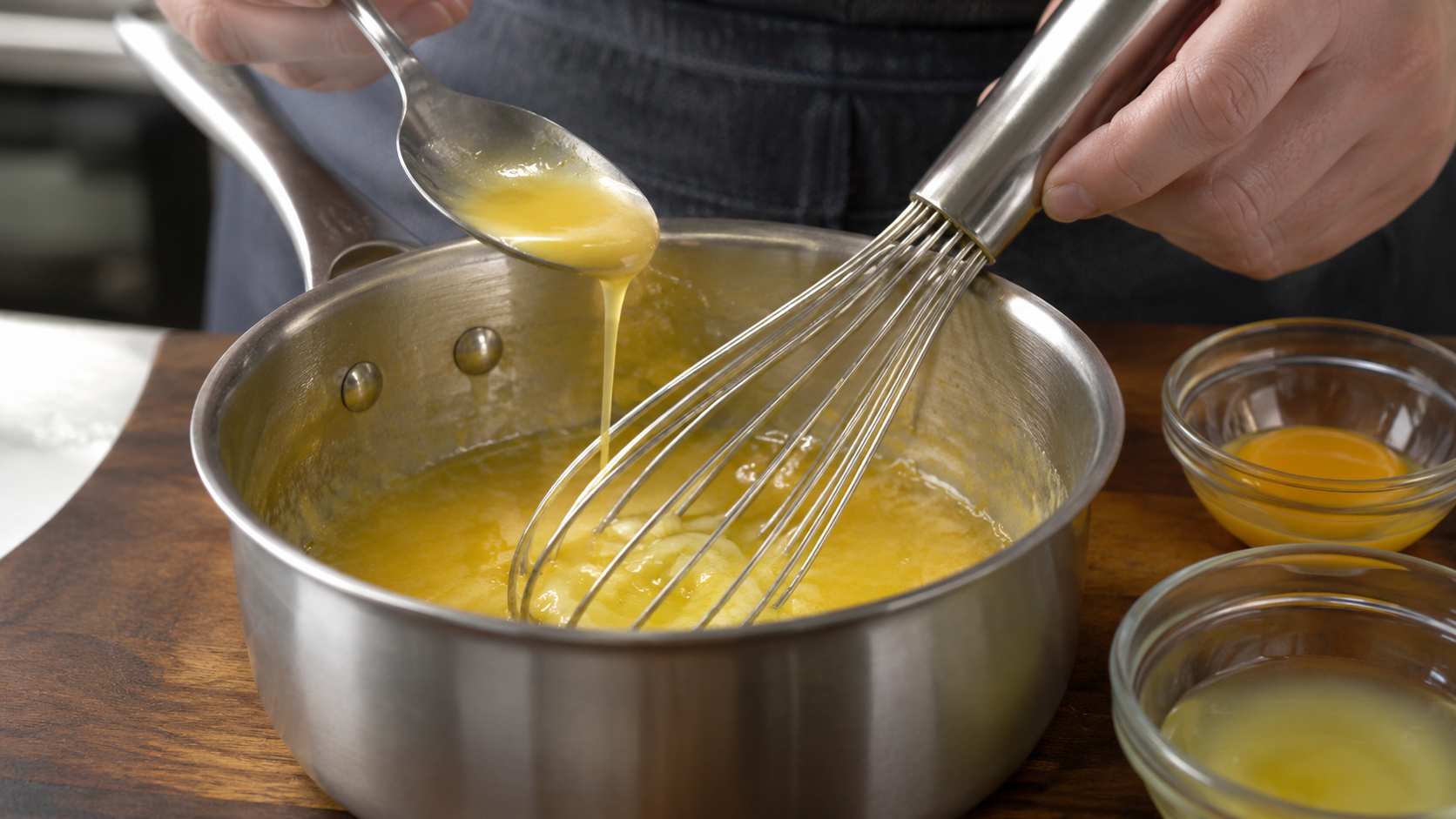
Most split sauces can be brought back. Take the pan off the heat immediately, put a tablespoon of fresh liquid into a clean bowl, and whisk the broken sauce into it a few drops at a time until it thickens, then in a slow stream. The fix works because you are rebuilding the emulsion from a stable starting point rather than trying to repair the broken one in the pan.
What splitting actually is
A sauce like hollandaise, mayonnaise or a butter sauce is an emulsion: tiny droplets of fat suspended in a small amount of water, held apart by something that stops them merging. In hollandaise and mayonnaise that something is egg yolk. In a pan sauce it may be gelatine from the stock or starch from the flour.
Splitting is those fat droplets finding each other and joining back up, which shows as a greasy layer separating out. It happens for three reasons: too much heat, fat added too quickly for the emulsifier to cope with, or too little liquid for the amount of fat.
Knowing which of the three caused it tells you which fix to use.
The fix for a hot butter sauce
Hollandaise, bearnaise and beurre blanc split from heat more often than anything else.
- Take the pan off the heat at once and stand it on a cold, damp cloth to stop the cooking.
- Put one tablespoon of cold water into a clean bowl.
- Whisk the split sauce into the water drop by drop at first, then in a thin stream once it starts to thicken.
- If it refuses to come together, start again with a fresh egg yolk and a teaspoon of water in place of the plain water, and whisk the split sauce into that instead.
The yolk method almost always works. A fresh yolk supplies new emulsifier, which is exactly what a heat-split sauce has run out of, and you lose nothing but one egg.
The fix for mayonnaise
Mayonnaise splits when the oil goes in too fast. The rescue is the same principle: a fresh yolk in a clean bowl, then the split mixture whisked into it very slowly. A teaspoon of Dijon mustard alongside the yolk helps, since mustard is itself a capable emulsifier.
If the mayonnaise is only slightly loose rather than properly broken, a tablespoon of boiling water whisked in vigorously will often pull it back without starting again.
The fix for a cream or cheese sauce
These split for a different reason. Dairy curdles when it gets too hot or meets too much acid, and what separates is protein rather than fat. Take it off the heat and whisk hard, which is sometimes enough on its own.
If it is still grainy, a teaspoon of cornflour slaked in cold water and whisked in over gentle heat will usually smooth it. A stick blender is the reliable last resort and rescues a cheese sauce that whisking cannot.
Cheese sauces split most often because the cheese went in while the pan was still on the heat. Add grated cheese off the heat and stir until it melts in the residual warmth.
When it will not come back
A sauce that has scrambled rather than split is not recoverable. If you can see solid lumps of cooked egg, the proteins have set and no amount of whisking will undo it. Straining will remove the lumps but leaves a thin sauce.
A sauce that has caught and burnt on the bottom is also finished, because the burnt flavour spreads through everything. Pour off what is above the burnt layer without scraping, taste it, and be honest.
Stopping it happening again
- Use a bowl over barely simmering water rather than direct heat, and never let the water touch the bowl.
- Add fat slowly at the start. The first third of the butter or oil is where emulsions are won or lost.
- Have all the ingredients at similar temperatures. Cold butter into a warm yolk mixture is a common cause.
- Keep a tablespoon of water or lemon juice to hand and whisk it in the moment the sauce looks thick or oily.
- Make it as close to serving as you can, and hold it somewhere warm rather than hot.
Split sauces feel like a disaster because they happen at the worst moment, usually with everything else ready. In practice the recovery takes two minutes and one clean bowl, and once you have done it a couple of times it stops being frightening at all.