
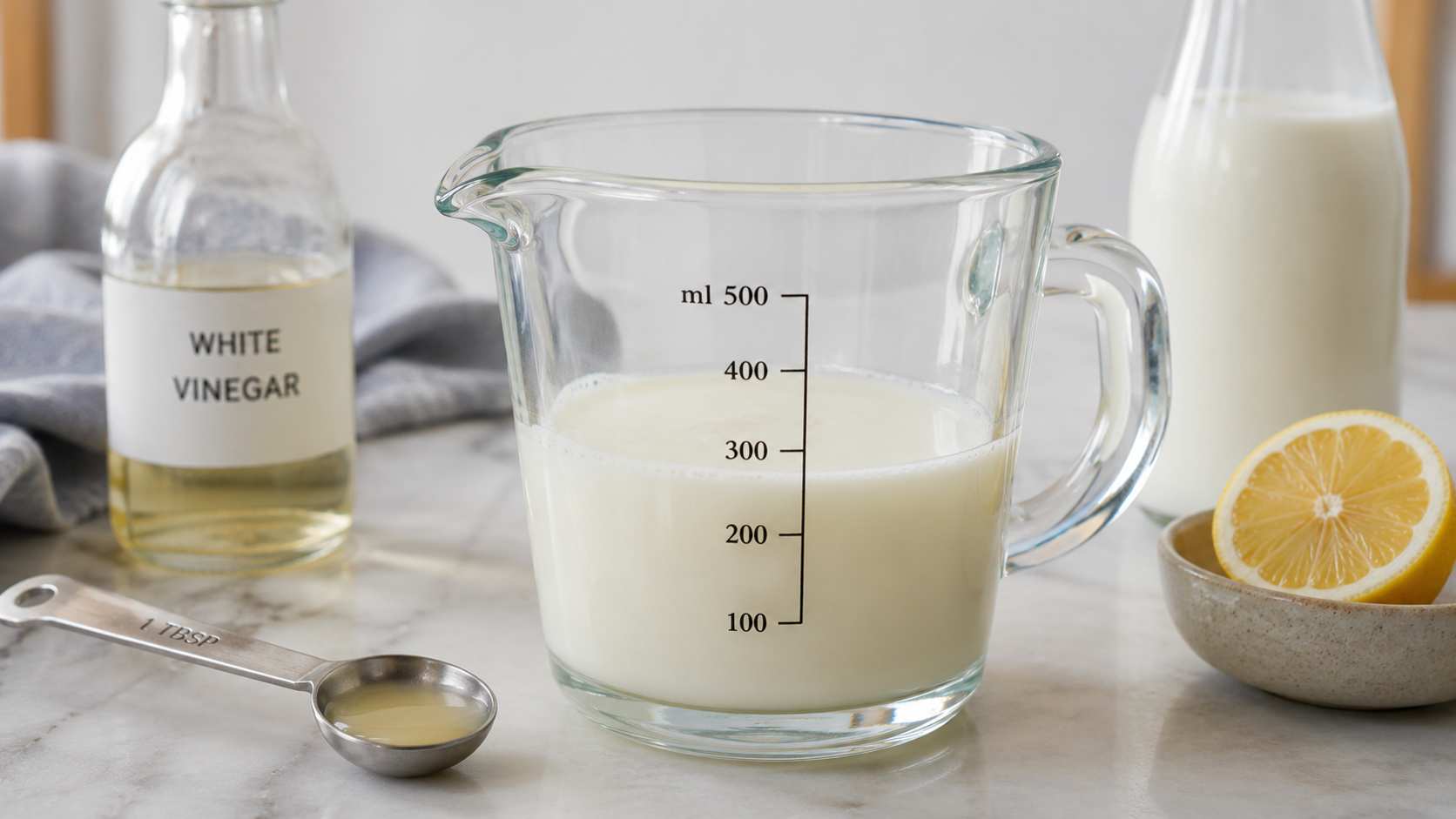
If you are out of buttermilk, stir one tablespoon of lemon juice or white vinegar into 250ml of ordinary milk, leave it to stand for ten minutes, then use it measure for measure in place of the buttermilk your recipe asks for. It will not thicken the way shop-bought buttermilk does, and that is fine. The job it is doing in your bake is chemical rather than textural.
What buttermilk is actually doing
Buttermilk is acidic, and that acidity is the whole point. In soda bread, scones, pancakes and most quick breads, the acid reacts with bicarbonate of soda to produce carbon dioxide, which is what makes the crumb rise and stay tender. It also softens gluten slightly, giving a shorter, more crumbly texture.
Once you know that, every substitution below makes sense: you are replacing an acid, not replacing a dairy product. Anything sour enough to set off the bicarb will do the job.
The soured milk method
This is the standard swap and the one worth memorising.
- 250ml milk plus 1 tablespoon lemon juice, or
- 250ml milk plus 1 tablespoon white vinegar
Stir, then leave it alone for ten minutes. It will look slightly curdled and thin. Whole milk gives the best result, semi-skimmed works perfectly well, and skimmed is noticeably weaker but still functional. Plant milks work too, though soya curdles most convincingly and oat barely curdles at all while still providing the acid.
Do not skip the ten minutes. The acid needs contact time with the milk proteins. Using it straight away still supplies acid for the bicarb, but the texture is thinner and the flavour sharper.
Other swaps that work
Plain yoghurt is the closest match by texture. Thin it with milk or water until it pours like single cream, roughly three parts yoghurt to one part liquid, then use the same volume the recipe asks for. Greek yoghurt needs more thinning than natural.
Soured cream behaves almost identically and is thinned the same way. Kefir needs no thinning at all and is a straight one-for-one replacement, being both acidic and already pourable.
Cream of tartar is the option that works when you have no acid liquid at all. Whisk one and a half teaspoons into 250ml of milk. It looks like nothing has happened, but the acidity is there.
Where the swap is invisible and where it is not
In scones, soda bread, pancakes, drop scones and most muffin recipes, nobody will be able to tell. These are quick, high-lift bakes where the acid reaction matters far more than the dairy character.
In buttermilk fried chicken, the substitution is more noticeable. Real buttermilk tenderises over several hours and its thickness helps the coating cling. Soured milk still tenderises and still works, but plain yoghurt thinned with a little water is the better stand-in here.
In a buttermilk panna cotta or anything where buttermilk is the headline flavour, use kefir or thinned yoghurt rather than soured milk. The tang of real buttermilk is a fermented flavour, not simply a sour one, and lemon juice in milk does not reproduce it.
Going the other way
If a recipe calls for ordinary milk and buttermilk is what you have, you can use it, but adjust the raising agent. Buttermilk with baking powder alone tends to produce a slightly heavy, faintly sour result. Add a quarter teaspoon of bicarbonate of soda per 250ml of buttermilk to neutralise the extra acid and get the lift back.
Quantities at a glance
- 125ml buttermilk: 125ml milk plus 2 teaspoons lemon juice or vinegar
- 250ml buttermilk: 250ml milk plus 1 tablespoon lemon juice or vinegar
- 500ml buttermilk: 500ml milk plus 2 tablespoons lemon juice or vinegar
- 1 cup buttermilk: 1 cup milk plus 1 tablespoon lemon juice or vinegar
The ratio is one tablespoon of acid per 250ml, and it scales cleanly in both directions. Do not be tempted to add extra acid for insurance, since too much makes the finished bake taste faintly metallic and can weaken the structure rather than helping it.
What does not work
Milk on its own is not a substitute. Without the acid there is nothing for the bicarbonate of soda to react with, and the result is flat, dense and slightly soapy from the unreacted raising agent. If the recipe uses baking powder rather than bicarb, plain milk is closer to acceptable, though the crumb will still be tougher.
Long-life buttermilk-flavoured drinks and buttermilk powder made up with water both work, but check the packet, since some are sweetened and will alter the balance of the recipe.