
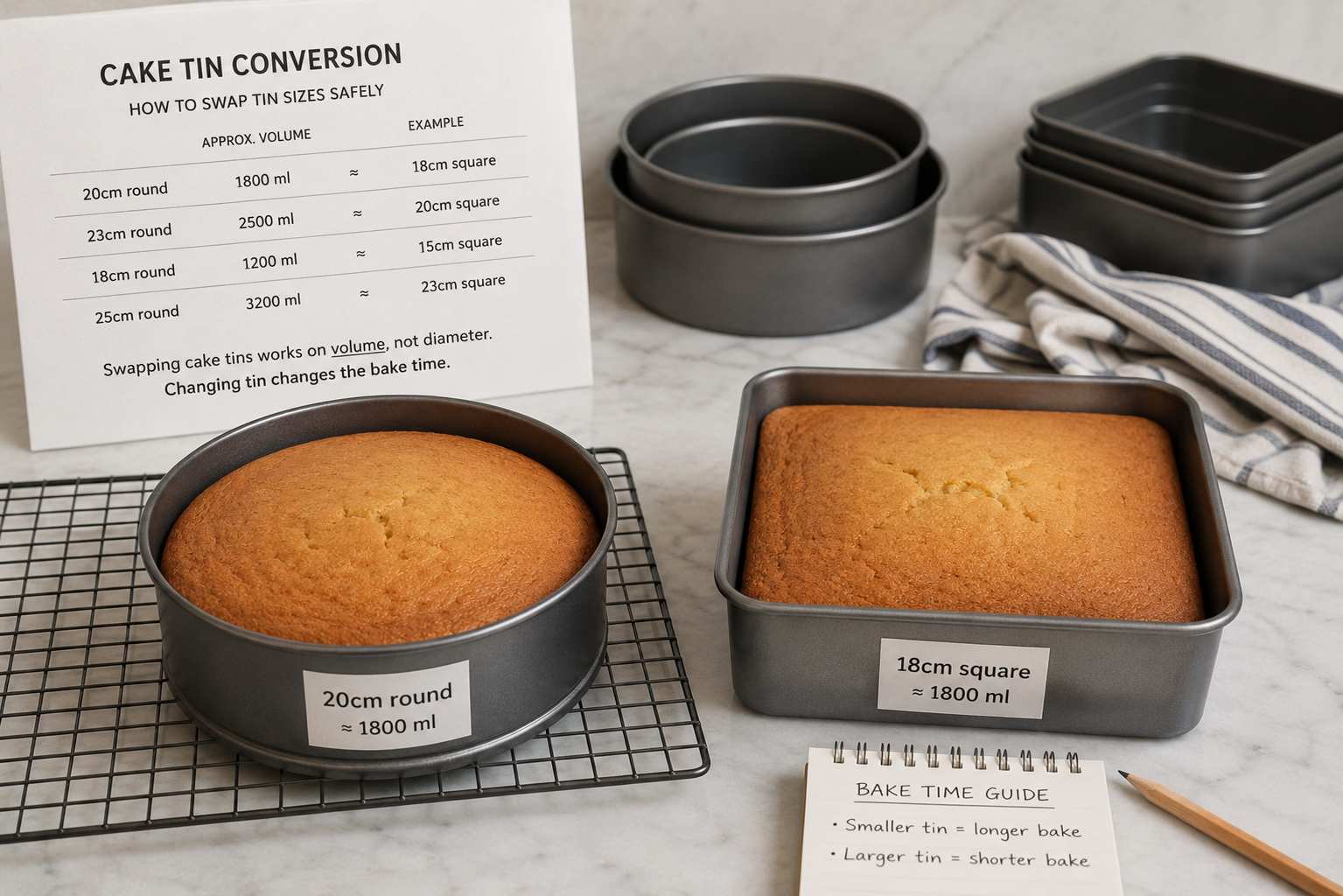
Cake tins are swapped by volume rather than by the number printed on the base. A 20cm round tin and an 18cm square tin hold almost exactly the same amount of batter, which is why that particular swap is the one every baker eventually learns. Once you change the tin, the depth of the mixture changes, and the bake time has to change with it.
How to work out the volume
The reliable method takes about a minute. Fill your tin with water to the depth you would fill it with batter, usually two thirds full, then pour that water into a measuring jug. That number is the capacity you need to match. Do this once for each tin you own and write it inside a cupboard door, and you will never need the arithmetic again.
If you would rather calculate, the area of a round tin is roughly three times the radius squared, and the area of a square tin is the side length squared. Multiply either by the depth. The practical upshot is the rule of thumb below.
A square tin holds more than a round tin of the same measurement. To swap a round recipe into a square tin, go down about 2cm. A 20cm round becomes an 18cm square, a 23cm round becomes a 20cm square, and so on in both directions.
Common tin capacities
- 15cm round, 7cm deep: about 1 litre
- 18cm round, 7cm deep: about 1.4 litres
- 20cm round, 7cm deep: about 1.8 litres
- 23cm round, 7cm deep: about 2.4 litres
- 18cm square, 7cm deep: about 1.8 litres
- 20cm square, 7cm deep: about 2.2 litres
- 900g loaf tin: about 1.5 litres
- 20cm by 30cm traybake tin: about 3 litres
Notice how much difference 3cm makes. Going from a 20cm round to a 23cm round increases capacity by a third, so a recipe made for the smaller tin will produce a noticeably shallow, quick-baking cake in the larger one.
Adjusting the bake time
The rule is simple even if the maths is not. Shallower batter cooks faster, deeper batter cooks slower, and the oven temperature stays the same.
If you move a recipe into a larger tin so the mixture sits shallower, start checking around three quarters of the stated time. A cake that was going to take 40 minutes may be done at 30. If you move it into a smaller, deeper tin, add roughly a quarter to the time and expect to cover the top with foil once it has coloured, because the outside will be ready long before the middle.
Always test rather than trusting the clock. A skewer into the centre should come out clean or with a few dry crumbs, and the cake should be starting to shrink from the sides of the tin.
The depth trap
Tin depth is the measurement people ignore, and it causes more trouble than diameter. Two 20cm round tins can hold very different amounts if one is 5cm deep and the other is 8cm. Sandwich tins are shallow by design, usually 4cm, and a recipe written for a deep 20cm tin will overflow two shallow ones.
As a working rule, never fill a tin more than two thirds full. A rich fruit cake that barely rises can go a little higher. Anything with a lot of raising agent should go no more than halfway.
Loaf tins and traybakes
Loaf tins are sold by the weight of bread they were designed for rather than by dimensions, which is unhelpful. A 450g loaf tin holds about 750ml and a 900g tin about 1.5 litres, so the larger is genuinely double the smaller despite the names suggesting otherwise.
A 900g loaf tin is a reasonable substitute for an 18cm round tin, though the cake will be deeper and will need longer. Traybake tins vary enormously between brands, so measure yours with the water method rather than assuming.
When not to swap at all
Some recipes depend on the tin in ways that volume does not capture. Swiss rolls need a shallow tin so the sponge stays thin enough to roll without cracking. Angel food and chiffon cakes need an ungreased tube tin, because the batter climbs the sides as it rises. Springform tins exist because cheesecakes and delicate bakes cannot be turned out.
For everything else, match the volume, watch the depth, and start testing early. A cake baked in the wrong tin at the right time is far better than one baked in the right tin for the wrong length of time.